Introduction
Big Picture
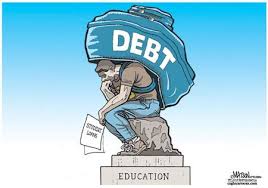
Education is undeniably one of the major indicators of financial success. By opening doors and creates opportunities for graduates and their descendants, as education is also linked to social mobility for families and therefore, putting children in a better position than the parents. While some Americans can plan for the financial toll of higher education by saving for tuition, many cannot. To combat this, many individuals will take out student loans to help finance their journey through academia. Loans give students the ability to pursue an education who otherwise would not be able to, due to the financial burden. However, it would be remiss to ignore the impact that repayment has on many graduates. These student loan balances, that once afforded eager students an opportunity, often start to feel like a monster in the hallway once they become graduates. While many individuals would like to start their life after graduation, and embark on the many milestones, like marriage and homeownership, these student loans oftentimes push the timelines back for some.
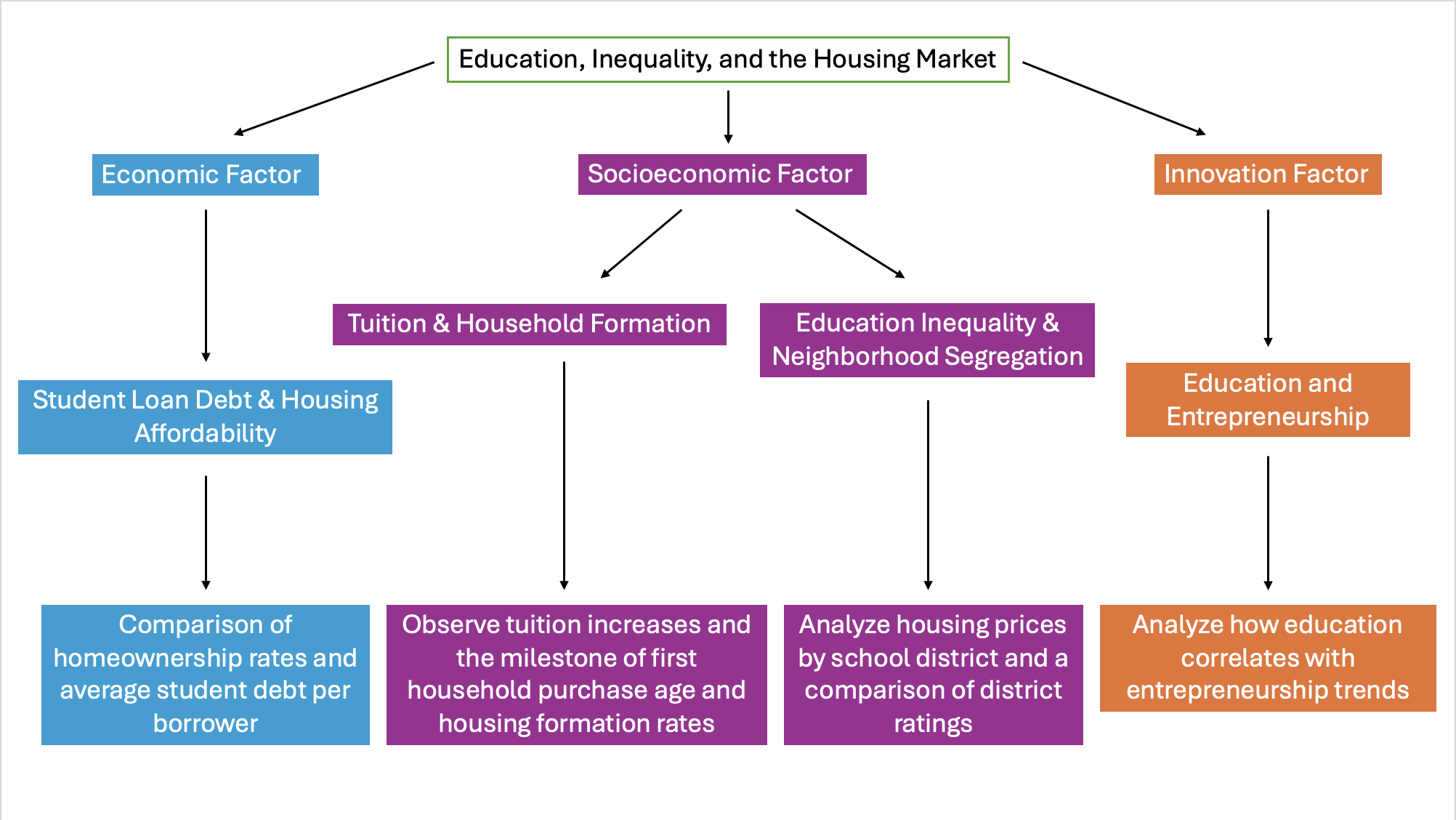
This analysis will focus on the socioeconomic intersection of the housing market and education within the United States. This area of interest will bring to light the way in which education opens doors, but not ignoring that fact that loans can create somewhat of a hinderance for many Americans. The scope will observe economic factors, socioeconomic factors, and innovation factors. The main research question is how does the housing market correlate with student loans? This, however, can be broken down into the smaller sub-questions as follows:

Student Loan Debt & Housing Affordability
How have student loan balances evolved in the U.S. over the last 20-30 years?
What is the relationship between student loan debt and homeownership rates among young adults?
Do changes in mortgage interest rates amplify or weaken the impact of student loan debt on housing affordability?
Tuition Growth & Household Formation
How have college tuition and fees grown relative to household income over time?
Is there a lagged relationship between tuition growth and the age of first-time homeownership?
Do increases in tuition lead to measurable delays in key life milestones, such as marriage and household formation?
Education Inequality & Neighborhood Segregation
How do housing prices differ across neighborhoods with high versus low performing schools?
Have these housing price gaps widened or narrowed over time?
What role do demographic and income disparities play in reinforcing education-driven housing segregation?
Education & Entrepreneurship
What is the correlation between educational attainment and entrepreneurship rates in the U.S.?
Have higher levels of student loan debt discouraged entrepreneurship, particularly among young adults?
Do periods of economic downturn shift the relationship between education and new business formation?
While education is widely known as an equalizer, there is increasing evidence that the financial costs of higher education is one that sticks with many for the long run. Much of the recent research connects student loans with major life milestones, such as homeownership, wealth accumulation, and entrepreneurship. These studies aid in the explanation of why the burden of student loans often stretches well beyond the classroom. Bleemer (2021) shows that increasing student loan debt delays homeownership among young adults. With the use of credit and mortgage data, Bleemer found that borrowers with high balances are significantly less likely to purchase a home, which suggests that the financial concern of repayment continues to shape household decisions years after graduation. Additionally, in an examination of how loan burden affect mortgage borrowing, Mezza, Ringo, and Sommer (2020) found that student debt also reduced the amount borrowers can receive when they do enter the housing market. The culmination of these two studies suggests that loans intended to expand opportunity may inadvertently delay wealth-building for young adults.
Student debt can also be examined with race as a factor. Addo, Houle, and Simon (2016) highlight the intersection of racial disparities with education financing. Their research shows that young Black borrowers carry disproportionately high debt loads, partly because of their parents’ lack of wealth. This disadvantaged starting point makes repayment more difficult, and delays access to the financial milestones that so many look forward to.
Together, this literature suggests that although education is a powerful tool for mobility, the financial structures surrounding it can create barriers to wealth and stability. These studies also highlight gaps that this project will seek to explore more directly: how student debt interacts with homeownership, how tuition growth growth delays housing formation, how education reinforces neighborhood segregation, and how education likes to entrepreneurship.